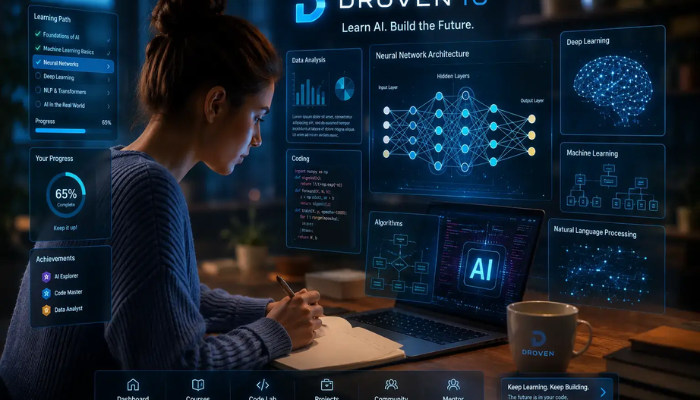
The droven io future of ai is becoming a compelling topic in the rapidly evolving technology landscape. Artificial intelligence is no longer a futuristic concept confined to science fiction. Today, AI influences how businesses operate, how consumers interact with technology, and how industries innovate to remain competitive. As organizations seek smarter solutions, platforms and concepts associated with Droven IO represent a vision where AI becomes more integrated, accessible, and transformative.
Understanding the droven io future of ai requires looking beyond simple automation. The future revolves around intelligent systems capable of learning, adapting, predicting outcomes, and enhancing decision-making processes. From healthcare and finance to education and manufacturing, AI-driven technologies are reshaping the foundations of modern society. This article explores the potential future of AI through the lens of Droven IO, examining emerging trends, business applications, technological advancements, ethical considerations, and the long-term impact on human progress.
The Vision Behind Droven IO Future of AI
The droven io future of ai centers on creating intelligent ecosystems that streamline operations while enhancing human capabilities. Unlike traditional software solutions that rely heavily on predefined rules, AI-driven platforms continuously learn from data and user interactions. This enables organizations to gain deeper insights, optimize workflows, and respond more effectively to changing market conditions.
One of the most significant aspects of this vision is scalability. Businesses increasingly need technologies that can adapt as they grow. AI systems inspired by the Droven IO approach aim to provide scalable intelligence that evolves alongside organizational requirements. Whether analyzing customer behavior, predicting market trends, or automating routine tasks, AI becomes a strategic asset rather than just a supporting tool.
Furthermore, the vision extends beyond corporate environments. Educational institutions, healthcare providers, and government organizations can benefit from AI-powered solutions that improve efficiency and service delivery. By combining advanced machine learning algorithms with user-centric design, the droven io future of ai highlights a future where technology works seamlessly alongside human expertise.
As AI capabilities continue to mature, organizations that embrace intelligent transformation will likely gain a competitive advantage. The integration of predictive analytics, natural language processing, and automated decision-making creates opportunities that were unimaginable just a decade ago.
How AI Automation Is Redefining Business Operations
One of the most influential aspects of the droven io future of ai is the expansion of intelligent automation across industries. Businesses are increasingly adopting AI tools to handle repetitive tasks, reduce operational costs, and improve productivity. Automation powered by machine learning can process vast amounts of data significantly faster than traditional methods.
Customer service is a prime example of this transformation. AI-powered virtual assistants and chatbots provide instant support, resolve common issues, and improve customer satisfaction. These systems continuously learn from interactions, becoming more effective over time. As a result, businesses can deliver personalized experiences while maintaining efficiency.
In addition to customer engagement, AI automation is revolutionizing supply chain management. Predictive algorithms help companies forecast demand, optimize inventory levels, and reduce waste. This proactive approach enables organizations to make informed decisions based on real-time insights rather than relying solely on historical data.
The droven io future of ai also emphasizes collaboration between humans and machines. Rather than replacing employees, AI enhances human performance by handling routine tasks and providing actionable insights. This allows professionals to focus on strategic initiatives, creativity, and complex problem-solving activities that require human judgment.
As automation technologies become more sophisticated, businesses that successfully integrate AI into their operations will likely achieve higher efficiency, greater profitability, and improved customer experiences.
Emerging Technologies Driving the Future of AI
The advancement of the droven io future of ai is closely linked to several emerging technologies that are accelerating innovation. Machine learning remains one of the primary drivers, enabling systems to identify patterns, make predictions, and improve performance through continuous learning.
Deep learning represents another breakthrough area. By utilizing neural networks modeled after the human brain, deep learning systems can process complex information such as images, speech, and natural language. These capabilities are fueling innovations in medical diagnostics, autonomous vehicles, and intelligent virtual assistants.
Natural language processing is also playing a crucial role in shaping AI’s future. NLP enables machines to understand, interpret, and generate human language with increasing accuracy. This technology supports applications ranging from automated customer support to advanced content generation and multilingual communication systems.
Another important contributor is edge computing. Instead of relying entirely on centralized cloud infrastructure, edge computing processes data closer to its source. This reduces latency and improves performance for AI-powered applications requiring real-time responses. Combined with the Internet of Things (IoT), edge AI creates smarter environments capable of making instant decisions.
The droven io future of ai benefits from the convergence of these technologies, creating intelligent ecosystems that deliver faster insights, enhanced automation, and more personalized user experiences. As innovation continues, the capabilities of AI systems will expand into areas that are currently only beginning to emerge.
The Role of AI in Industry Transformation and Economic Growth
The droven io future of ai is expected to have a profound impact on global industries and economic development. Organizations across various sectors are investing heavily in AI-driven technologies to improve efficiency, innovation, and competitiveness.
In healthcare, AI supports disease detection, medical imaging analysis, and personalized treatment recommendations. These advancements enable healthcare professionals to make more accurate diagnoses and improve patient outcomes. AI-powered predictive models also help identify potential health risks before they become serious conditions.
The financial sector is experiencing significant changes as well. Banks and financial institutions use AI for fraud detection, risk assessment, algorithmic trading, and customer service automation. These applications enhance security while improving operational efficiency and customer experiences.
Manufacturing industries benefit from predictive maintenance systems that monitor equipment performance and identify potential failures before they occur. This reduces downtime, lowers maintenance costs, and increases productivity. Similarly, retail companies leverage AI to personalize marketing campaigns, optimize inventory management, and improve customer engagement.
The broader economic implications are equally significant. The droven io future of ai has the potential to create new industries, generate employment opportunities in emerging technology fields, and drive innovation across global markets. While workforce adaptation remains important, AI’s contribution to productivity and growth could become one of the defining economic forces of the coming decades.
Ethical Considerations and Challenges in the AI Future
While the opportunities presented by the droven io future of ai are substantial, they also raise important ethical and societal questions. Responsible AI development requires careful consideration of privacy, transparency, accountability, and fairness.
Data privacy remains one of the most pressing concerns. AI systems rely heavily on data to learn and make decisions. Organizations must implement robust security measures and ethical data practices to protect user information and maintain trust. Transparent data governance frameworks are essential for ensuring responsible AI deployment.
Algorithmic bias is another challenge that requires attention. AI models trained on biased datasets may produce unfair outcomes that affect individuals and communities. Developers must prioritize fairness and inclusivity throughout the design and implementation process to minimize unintended consequences.
Workforce disruption is frequently discussed in relation to AI adoption. While automation may replace certain repetitive tasks, it also creates opportunities for new roles focused on AI management, data analysis, and technological innovation. Education and reskilling initiatives will play a crucial role in preparing workers for the evolving job market.
The droven io future of ai highlights the importance of balancing technological advancement with ethical responsibility. By establishing clear regulations, promoting transparency, and prioritizing human-centered design, society can maximize AI’s benefits while addressing potential risks.
Conclusion
The droven io future of ai represents a powerful vision for a world increasingly shaped by intelligent technologies. From automation and predictive analytics to industry transformation and economic growth, AI is becoming a fundamental driver of innovation across nearly every sector. As emerging technologies continue to evolve, AI systems will become more capable, efficient, and integrated into everyday life.
However, the future of AI extends beyond technological progress alone. Success will depend on responsible development, ethical implementation, and a commitment to ensuring that AI benefits society as a whole. Organizations, governments, and individuals must work together to harness AI’s potential while addressing challenges related to privacy, fairness, and workforce adaptation.
Ultimately, the droven io future of ai reflects a future where human creativity and machine intelligence collaborate to solve complex problems, unlock new opportunities, and shape a smarter, more connected world.
Frequently Asked Questions (FAQs)
1. What is the droven io future of ai?
The droven io future of ai refers to the evolving role of artificial intelligence in driving innovation, automation, and intelligent decision-making across industries.
2. How will AI impact businesses in the future?
AI will improve efficiency, automate repetitive tasks, enhance customer experiences, and provide data-driven insights for better decision-making.
3. What technologies support the future of AI?
Machine learning, deep learning, natural language processing, edge computing, and IoT are among the key technologies driving AI advancement.
4. Will AI replace human workers?
AI is more likely to transform jobs rather than eliminate them entirely, creating new opportunities while automating routine tasks.
5. How does AI improve customer service?
AI-powered chatbots and virtual assistants provide instant responses, personalized support, and continuous service availability.
6. What industries benefit most from AI?
Healthcare, finance, manufacturing, retail, education, and logistics are among the industries experiencing significant AI-driven transformation.
7. Why is ethical AI important?
Ethical AI helps ensure fairness, transparency, privacy protection, and responsible decision-making in AI systems.
8. What role does data play in AI?
Data serves as the foundation for AI learning, enabling systems to identify patterns, make predictions, and improve performance.
9. How can organizations prepare for AI adoption?
Businesses can invest in employee training, develop AI strategies, establish governance frameworks, and implement scalable technologies.
10. What is the long-term outlook for AI?
The long-term outlook for AI is highly positive, with continued innovation expected to drive productivity, economic growth, and technological advancement worldwide.